A Scottish farmer named this place after the ferns and the low hills that reminded him of home.1 Those hills are the point: Brackenfell's highest ground is 177 m, and nothing here is going to shade your house for you. This is a year in a Brackenfell home, month by month, and what we would fit when.
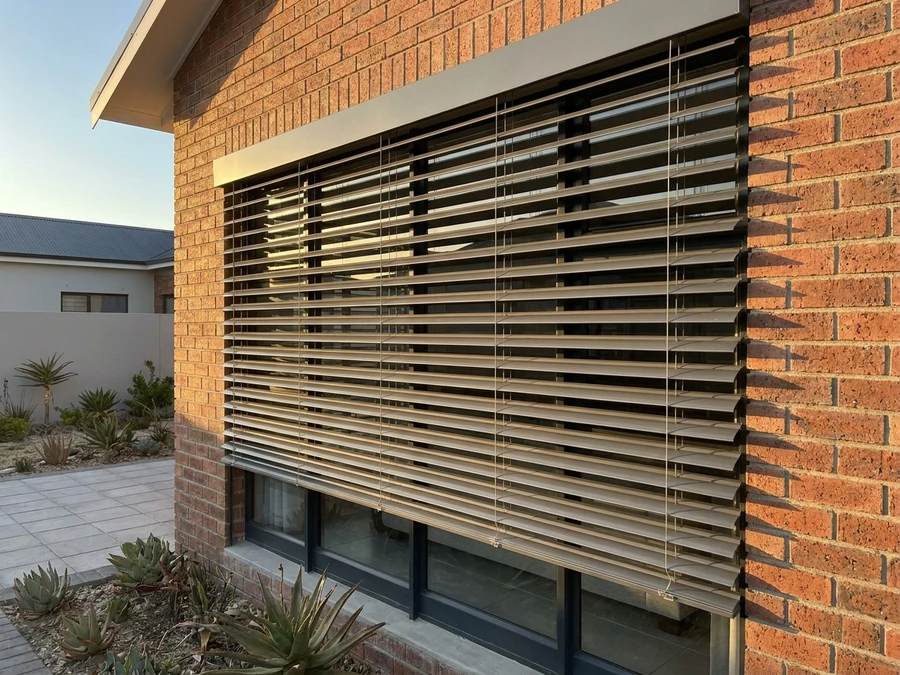
Brackenfell, late afternoonBlades outside the glass — the west wall answered before the heat gets in
Short on time? Grab the PDF and come back to it — 14 pages.
Why this guide runs on a calendar
Almost every Brackenfell home we walk into has the same shape to its story. Someone moved in — a new build, a resale, a renovation that finally finished — and the windows were the last thing on the list. Then summer arrived and made them the first thing.
So this guide is not organised by product. It runs on a calendar: what a Brackenfell house asks of you in month one, month three, month six and month twelve, and what we would fit at each of those points if the budget could only stretch one step at a time. Every figure has a source at the bottom of the page. Where we could not check something, it is simply not here.
Two facts set the whole thing up. Brackenfell sits about 30 km north-east of Cape Town, at the gateway to the Winelands, with the Bottelary Hills on its south-eastern flank and its own highest point — Kanonkop, in Ruwari — reaching just 177 m.1 That is gently rolling farm country, not mountain country. No ridge, no mountain shadow, no early sunset. The only free shade a Brackenfell house owns is its own roof, and by mid-afternoon in summer even that has stopped working.
Second: it gets properly hot here. February is the warmest month, averaging highs around 26 °C, and the suburb is inland enough that the sea breeze cooling the coast most afternoons rarely reaches this far.2
Month one — the house comes with bare glass
Handover in South Africa means the glass is bare, and a Brackenfell floor plan makes that immediately obvious: the lounge-dining opens onto the patio through a wide sliding or stacker door, and that door is both the best thing about the room and the whole heat problem, in the same pane.
The temptation in month one is to cover everything cheaply and uniformly. We would rather you did the opposite: cover the two rooms that genuinely cannot function, and leave the rest until you have lived through one summer and know which walls actually bake. Bedrooms first, because sleep is not negotiable and blockout fabric is the cheapest real solution in the house. Then the room you sit in after four.
The month-one shortlist
Blockout rollers in the bedrooms; a sunscreen roller or a day-and-night banded blind on the street-facing living glass so you get privacy without giving up the garden. That is it. Everything else in this guide can wait for information you do not have yet.
Month two — find out which wall bakes, and from what time
This is the exercise we would ask you to do before spending anything serious, and it costs nothing. Open the compass on your phone, walk each room, and write the heading on a piece of paper taped inside a cupboard door. Then, on the next hot Saturday, note the time each room becomes unpleasant.
You will end up with something close to this, because the geometry is fixed. Brackenfell sits at roughly 33.9° south, so the midsummer noon sun stands about 79.6° above the horizon, the equinox sun about 56°, and the midwinter noon sun about 32.7°.3 Three consequences follow:
North glass is not your summer problem. At almost 80° the sun is nearly overhead, and any normal eave or upper-floor overhang shades the window at midday. Fit an off-switch there and you will regret it in July.
East glass is a morning glare problem against a cool house — cheap to fix from the inside, and not worth an exterior product.
West glass is the expensive one, and it stays expensive until you deal with it properly. That is the next section.
Month three — the first real December, and the stacker door
By late afternoon in December the sun has dropped low in the west and is arriving almost horizontally — underneath every overhang the house has. That is why a west-facing stacker door can be pleasant at noon and unusable at five with nothing having changed except the angle.
Here is the part worth being blunt about. An interior blind on that door does not stop the heat. The sun is already through the glass by the time it reaches the fabric; the pane heats, the fabric heats, and the room collects both of them long after sunset. An interior blind is a glare tool. On a big west opening it is not a heat tool.
Heat has to be stopped outside the glass, and there are three ways we do that in Brackenfell — in this order:
External venetian shading. Wide aluminium blades mounted outside the window, tilted or lifted through the day. Best of both: the sun is intercepted before it reaches the pane, and you still steer the light and keep the garden. Our first recommendation on a west living wall.
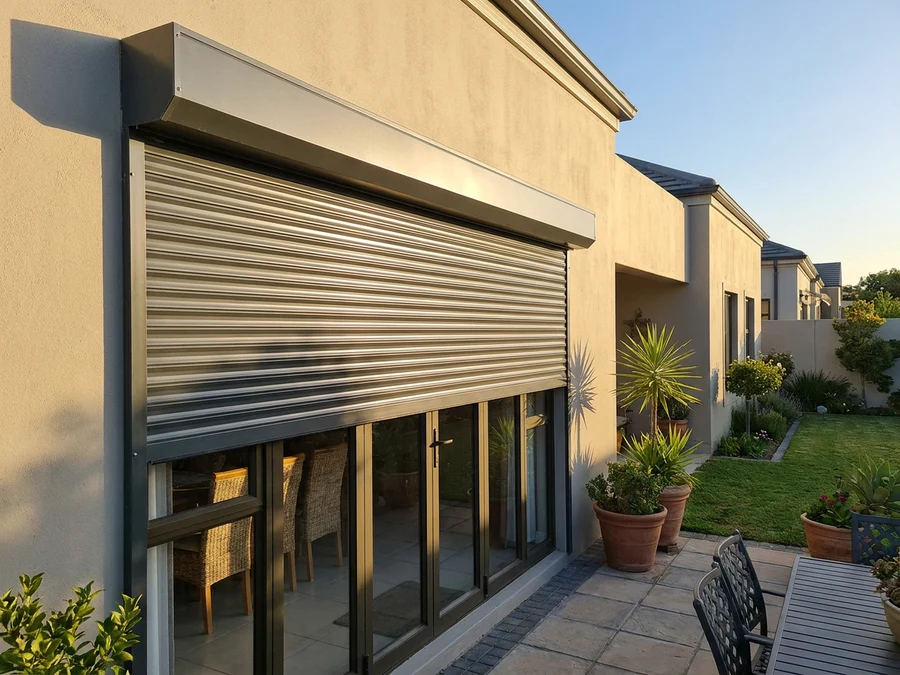
Roller shutters. A slat curtain in rigid aluminium, unrolling outside the glass from a box above it — the strongest heat and dark control we fit, and the calmest in wind. Stated plainly: what they control is sun, heat, glare and light. Nothing about them is security-rated, and that is a different item altogether, which we will quote separately if you ask.
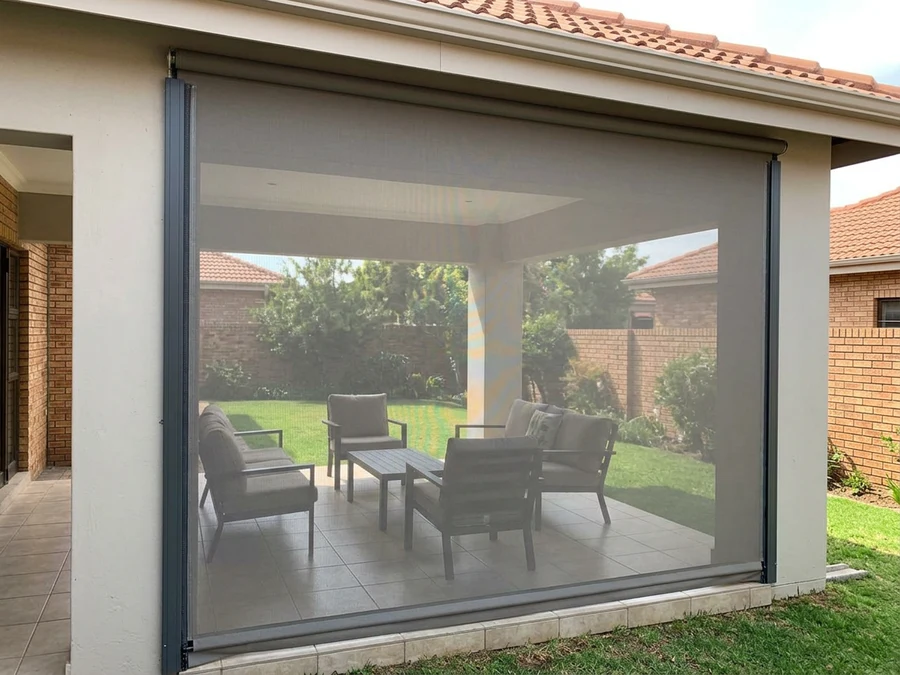
Zip screens. Mesh tensioned into side channels down the sides of a covered patio. The right call when the problem is the outdoor room rather than the window — it holds its shape in wind and closes the braai area in without walling it off.
And the honest fallback, because not every budget or every wall allows an exterior fixing: a tightly woven sunscreen fabric on the inside, or mesh in front of blockout on a twin bracket. Real improvement in comfort, meaningfully less heat rejected. We will not tell you the two are the same thing.
Half-drop on a patio door: the upper part of the glass is closed off, which is exactly where the low sun is coming from, and you still see out at eye level.
Month four — January, and the wind you forgot about
January is Brackenfell's windiest month, averaging around 17.6 km/h and running well above that on the strong days.2 It is the south-easter — the Cape Doctor — which blows through the summer entertaining months right when the patio is in daily use.4
That matters because everything recommended in month three lives outside the building. Our standing rule here is simple and it is not an upsell: if it is motorised, it lives outside and the stand is open, it gets a wind sensor. The sensor pulls the fabric or the awning in before the gust lands, instead of waiting for somebody to be home and notice. Behind a high boundary wall, in a courtyard the wind never really finds, we will tell you to save the money.
Wind is also the reason we push a tensioned zip screen over an open folding-arm awning on a genuinely exposed patio. A folding-arm awning is the better product where you want the sky back in winter; a zip screen is the better product where the wind is the thing spoiling the room.
Zip screen down the open side of a covered patio — the mesh is held in channels, so a January gust does not turn it into a sail.
Month six — autumn, and the temptation to over-fix
By April the equinox sun sits around 56° at noon3 and the house feels reasonable again. This is the moment people either lose interest, or — having been cross about it all summer — over-specify.
Both are mistakes, in opposite directions. The correction is to think in layers rather than in products. Most Brackenfell living rooms end up wanting two things from the same window at different hours: a filter during the day and a barrier at night. A double roller does that on one bracket. A day-and-night banded blind does a lighter version of it by offsetting bands. Neither is exotic and neither is expensive relative to redoing the job twice.
One limit to know before you buy: mesh only works one way, and only in daylight. Come evening, with the lamps on and the garden dark, the arrangement inverts and you are the lit side. On a street-facing lounge that is the single most common complaint we get called back about, and it is entirely avoidable at specification stage.
Protea Heights. Bands offset for daylight, closed for the evening — the same blind doing two different jobs.
Month nine — June, and the opposite complaint entirely
Cape winters push real rain through from about May to August, and by then nobody is asking about heat. They are asking about the guest room that runs cold, or the room above the garage that never quite dries out. The midwinter noon sun only reaches about 32.7°3 — low, welcome, and completely absent from a south-facing room.
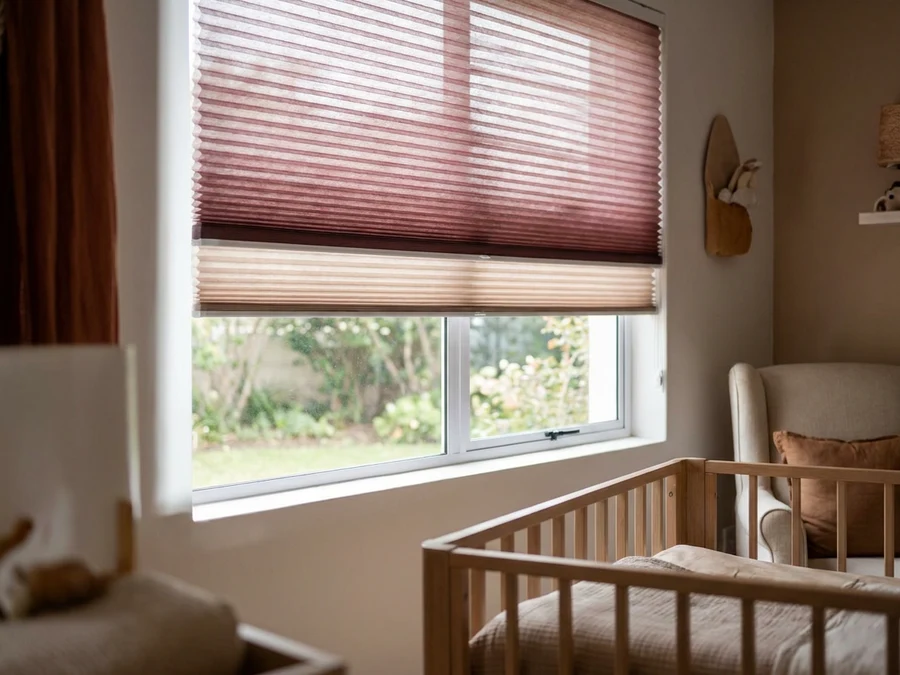
Two practical answers. First, cellular honeycomb blinds in the cold-running rooms: the air trapped inside the cells is the insulator, and it does something a flat fabric genuinely cannot. Second, in bathrooms, sculleries and laundries, aluminium slats rather than timber. Brackenfell is inland — there is no salt in the air here to corrode hardware — but winter condensation in a low-airflow room is real, and timber does not enjoy it.
This is also the season that justifies not blacking out the north side back in December. Low winter sun coming deep into a north living room is free heat, and switching it off in summer means switching it off in July too.
The honeycomb is not decoration — the trapped air inside those cells is the whole reason the room holds its warmth.
Month twelve — what people actually change in year two
By the second summer, most households have learned the same three lessons, and it is cheaper to hear them now than to buy them twice.
Lesson oneThe west wall was always going to need something outside the glass. Interior fabric bought a season of patience, not a solution.
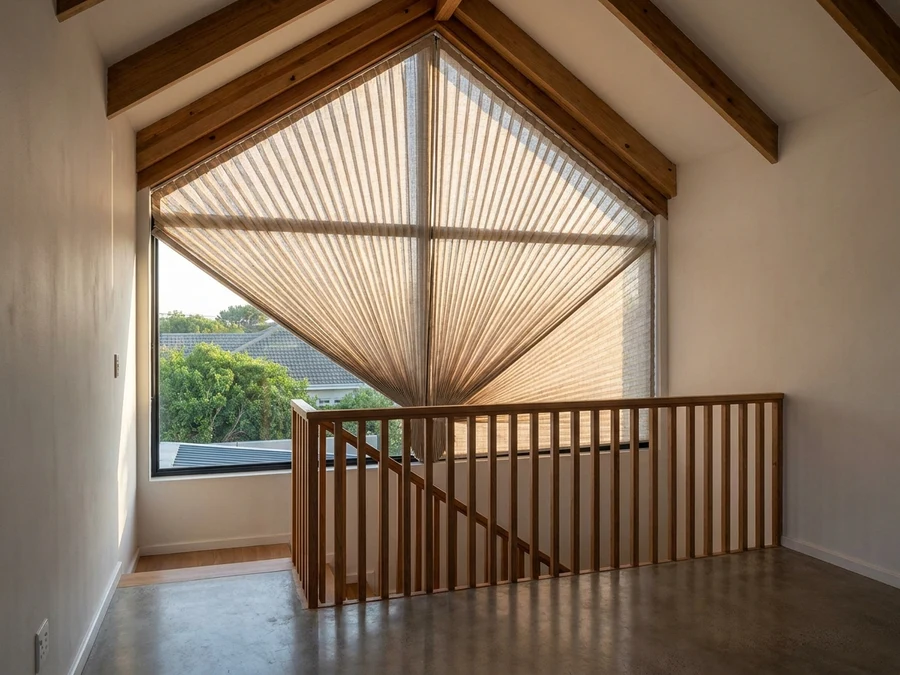
Lesson twoThe run of windows nobody wants to operate by hand gets motorised — a stairwell gable, a high clerestory, a five-panel stacker run. One command beats five chains, and there is nothing dangling where small hands reach.
Lesson threeThe rooms that were left bare in month one stayed bare far longer than anyone intended. Doing the whole house in one measure is usually cheaper per window than three visits over three years.
The gable over the stairwell: made to the actual angle, and motorised, because nobody is getting a ladder out twice a day.
Where in Brackenfell you are changes the answer
Brackenfell is not one place. It runs north, central and south across more than thirty residential neighbourhoods,5 and the practical differences are real:
Vredekloof is one of the older hillside pockets, with decades-old canopy over some rooms and open sky over others, and living areas stepped across the slope. Shade there is genuinely uneven — which is exactly why one blanket specification for the whole house is the wrong answer.
Sonstraal Heights sits on higher ground toward the western edge, built to make use of the elevation: wider windows, doors onto a view, and more wind than the sheltered streets lower down. Everything exterior here gets motorised and wind-sensored as a matter of course.
Protea Heights runs to practical family homes on smaller stands with standard openings — fewer architectural quirks, fewer surprises at quote stage, and a lot of children's rooms where cordless or motorised control matters more than fabric choice.
Kraaifontein, immediately east, mixes older steel-frame windows with newer aluminium openings, often on the same street. An older steel casement can be out of square in ways a new frame never is, so the bracket has to suit what is actually there.
Under all four sits the same geography: gently rolling ground, no relief above 177 m, and neighbouring suburbs — Bellville west, Kraaifontein east, Durbanville north, Kuils River south — sharing the same weather and the same problem.1
Vredekloof. Old canopy over one room and open sky over the next is exactly why a single blanket specification fails here.
Five things a floor plan will never tell you
The true heading of each room. Streets here run at every angle, and plenty of houses were placed to suit the stand rather than the road. Everything above depends on this being right.
Reveal depth, checked at head, middle and sill. It settles whether the blind sits in the opening or across it, and that is what a genuinely dark bedroom turns on.
What is actually holding the plaster up. Brick, cavity or a later stud partition changes the fixing entirely, and settles whether the outside of that wall can carry anything at all.
How exposed your stand actually is. A walled courtyard and an open corner plot two streets apart are different jobs in a January south-easter.
Power, and how you will service it. A motor needs a supply it can reach; a battery tube needs to come down for charging without anyone balancing on a stepladder.
Those five are why the visit exists, and why we do not charge for it. Finding them out early costs nothing. Finding them out late costs a refit.
Have it read for your house
The guide is general. Your west wall isn't.
Someone comes out with a sample case and a compass, works through the five unknowns above, measures every opening, and writes the quote up window by window. Free, either way.
References
Sources
If a number appears above, it came from one of these. The sun angles are derived from Brackenfell's latitude with standard solar geometry — the working is shown in the text if you want to run it yourself — rather than lifted from a single page. If we could not confirm something, it simply is not here.
Wikipedia — Brackenfell: established 1913 on the farm Kruispad, bought in 1901 by the Scottish immigrant G. H. Walton, who named it for flora that reminded him of Scotland (bracken meaning fern, fell meaning hill); a railway station from 1904; roughly 30 km north-east of Cape Town and 35 km south-west of Paarl; the gateway to the Cape Winelands and the start of the Bottelary Hills wine route, with Stellenbosch about 22 km to the south-east; flanked by the Bottelary Hills to the south-east; highest point Kanonkop at 177 m in Ruwari; bordered by Bellville, Kraaifontein, Durbanville and Kuils River.
Climate-Data.org — Brackenfell climate, with monthly wind and temperature detail from Weather Atlas: February the warmest month with average highs near 26 °C; January the windiest month, averaging about 17.6 km/h; May the calmest.
Sun angles derived for latitude ≈33.9° S. Take 90°, subtract the gap between the latitude and the sun's declination (which runs to ±23.44° at each solstice), and you get roughly 79.6° at midsummer noon, 56° at the equinoxes and 32.7° at midwinter noon. Cross-referenced with the published Cape Town sun data at timeanddate.com.
The south-easter, covered by Wikipedia and by Cape Town Magazine: the Cape's dominant warm-season wind, running right through the months a patio gets used.
Century 21 South Africa — Brackenfell area profile: the suburb divided into north, central and south, covering more than thirty residential neighbourhoods including Vredekloof in the north and Protea Heights and Ruwari in the south.
Everything specified on this page is our own view, freely given. It is not a permissions opinion — a complex, estate or body corporate that governs the look of a facade decides those questions, and we put that on the table before the quote goes out rather than after.
Whenever you're ready
Read the whole year, then call us.
There is no rush and nothing to sign. When the west wall wins the argument, one of our expert consultants will come and measure — free, in writing, per window.